Images
6 / 6
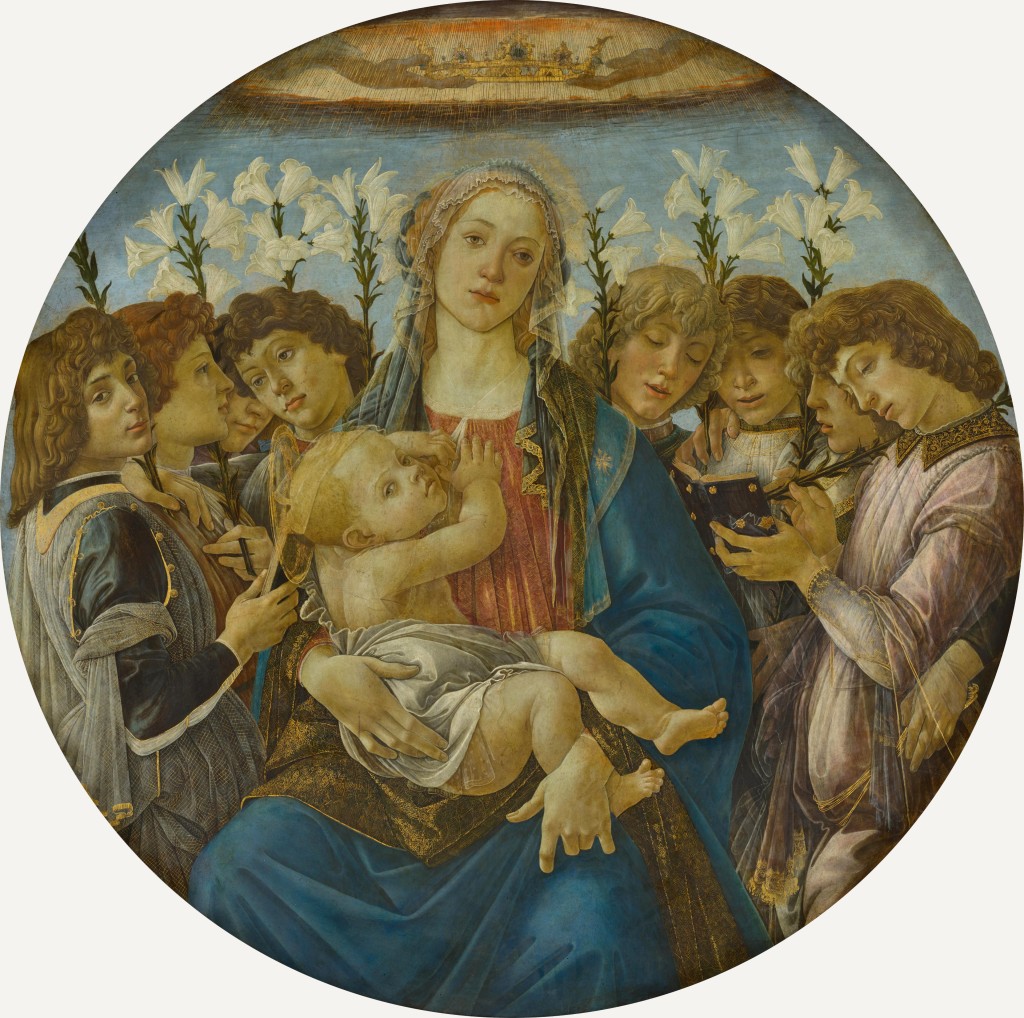
Maria with the child and singing angels
Christmas Story, Image 212
Audio transcription
Benjamin Britten composed „A Hymn to the Virgin“ when was just 17 years old. Yet the double four-part movement with half of the choir singing in English, the other in Latin radiates maturity, composure, even tranquility. This movement draws from an anonymous poem written in the thirteenth century and recorded in the Oxford Book of English Verse. It glorifies Mary as the luminous counter figure to sinner Eve, „brighter than the day is light“, „flow’r of everything“, „queen of paradise“ and „maid mild, mother“. And it continues: „The well springeth out of thee / Virtutis“.
Sandro Botticelli visually presents these features of the godmother in his circular painting: Mary’s face, tranquil and solemn and the ideal of worldly feminine beauty, bears an indistinct expression that conveys depth and melancholy. The celestial queen gently holds Jesus, the son of God, in her arms, wrapped in her magnificent blue mantle. The child, looking directly at the viewer, grabs Mary’s breast that offers golden milk. Botticelli paints the scene with incredible detail. The godmother is the compassionate mother of the sacrifice that Jesus is determined to be. She, the mother of all humankind, bestows virtue and salvation.
Surrounded by singing angels and white lilies, symbols of purity and Botticelli’s hometown Florence, crowned by heaven, Mary takes the middle of this supertemporal representational painting. She rests within herself and pacifies the complete scene. The peace of Christmas reigns.
Full Length Music
Benjamin Britten (1913–1976)
„A Hymn to the Virgin“
RIAS Kammerchor Berlin
1930
Details
Maria with the child and singing angels (around 1478),
Sandro Botticelli,
Poplar wood,
136.5 × 136.0 cm
Staatliche Museen zu Berlin, Gemäldegalerie / Dietmar Gunne